CHEMICAL COMPOSITIONS OF
FIELD DISK STARS
HOME |
TEACHING |
HALOSTARS |
DISKSTARS |
LABDATA |
MOOG |
SPECTRE |
MISC
|
Red Horizontal-Branch Stars in the Galactic Disk
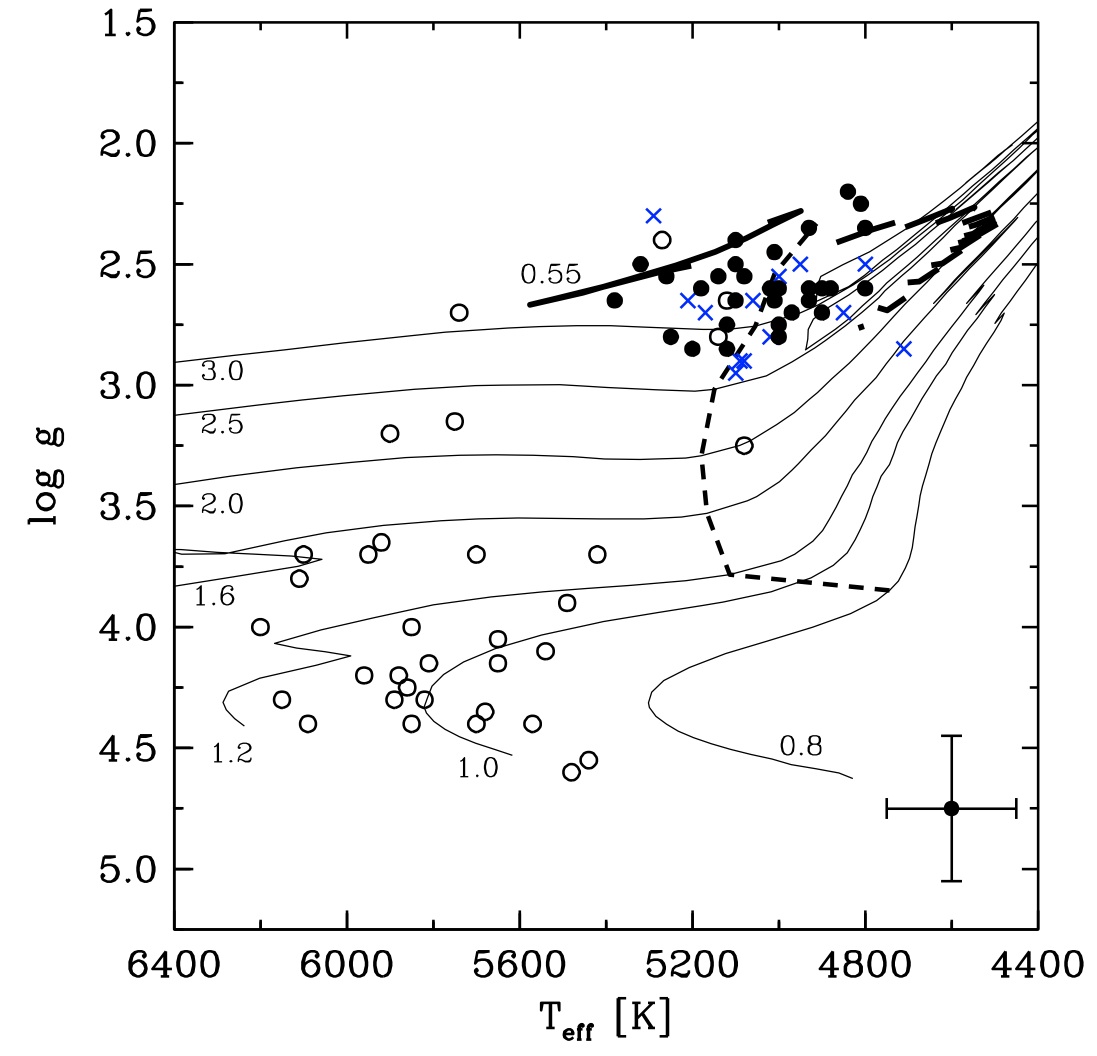
Horizontal-branch (HB) stars are relatively low-mass objects that are fusing helium quiescently in their cores. They have arrived on HB usually after experiencing the He-flash at the end of their first ascent of the red-giant branch. Metal-rich, Population I HB stars occupy a small domain in HR Diagram (Teff ~ 4900K, MV ~ 1) called the red clump. More metal-poor lower-mass thick disk and halo stars lie on the HB at roughly the same absolute magnitude but with temperatures than can range from T~5000K to T>15000K, depending on their masses and metallicities. Such stars are labeled red HB (RHB), variable RR Lyr, blue HB (BHB) and extreme blue HB (EBHB) as their temperatures.
Recently Melike Afşar and her group at Ege University's Department of Astronomy and Space Sciences have been collaborating with me in a spectroscopic investigation of purported RHB stars in the field. We wanted to know why there appear to be so many of them that are relatively bright. If they are all thick disk stars they should be few in number. In our first study, we identified 18 true field RHB stars. Surprisingly however, 13 of these stars are members of the high-metallicity thin-disk population, contrary to our expectations that all would be thick-disk, modereately metal-poor stars.
|
|
|
|
Acknowledgments
All of the research described here has resulted from the collective efforts of large numbers of people, including my current and former students, and investigators at many astronomical institutions around the world. Their contributions are gratefully acknowledged. For many years I have benefited from grants by the U.S. National Science Foundation and the National Aeronautics and Space Administration. Their support has been crucial to my research.